- The Moral Universe
- Posts
- The Companies Who “Souled Out”
The Companies Who “Souled Out”
Can we achieve a moral and ethical business environment?

Bill Liao
November 29, 2025
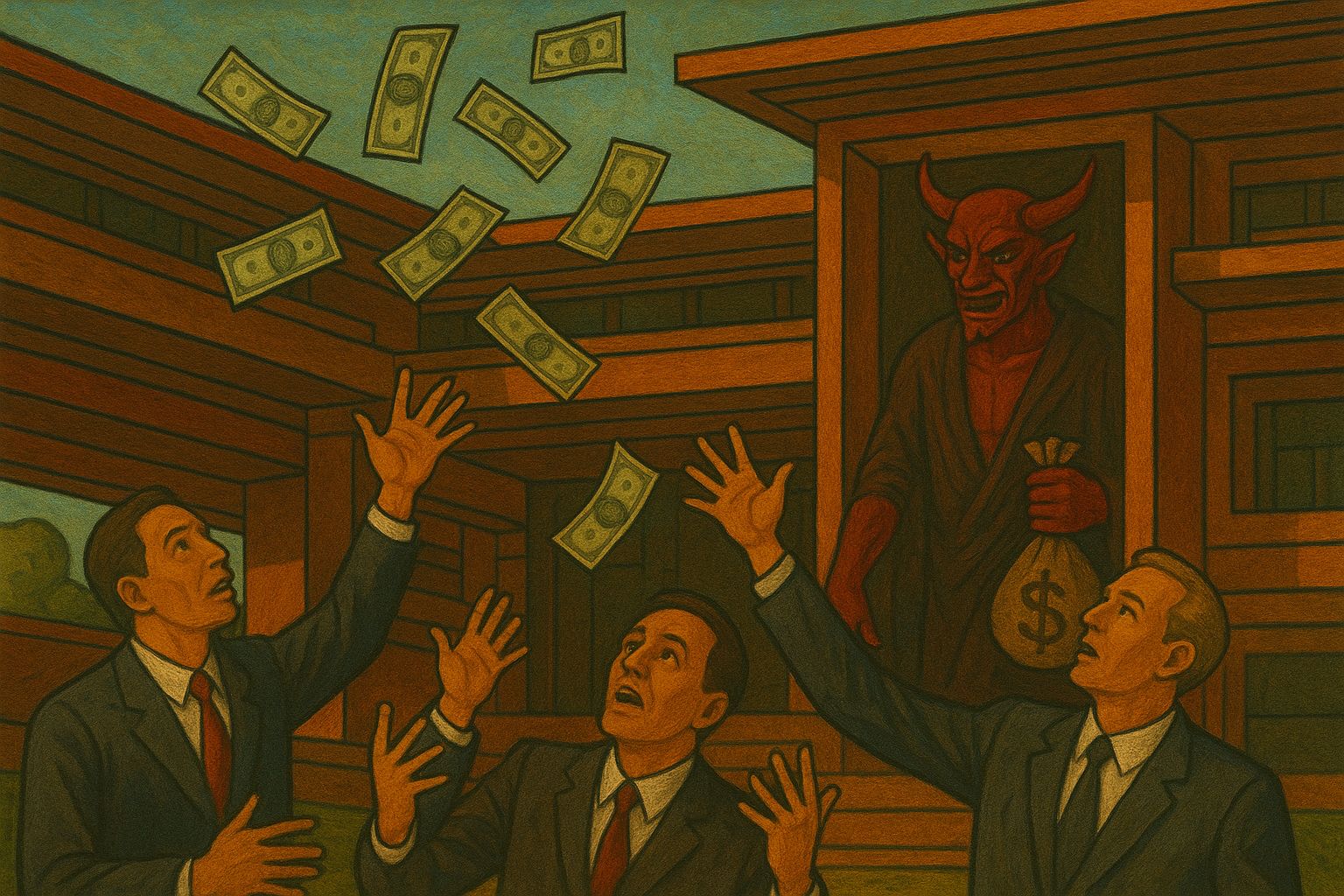
There is a deeper story behind the rapid corporate retreats from previously stated values that we’re seeing right now. It’s not simply that companies are abandoning diversity initiatives, sustainability pledges or ethical technology principles.
It is that short-term goals are triumphing over long-term values, even when those values were presented as essential to a company’s identity and more importantly its brand. Branding is essential to generating value and when companies compromise their values and branding they compromise customer trust.
You can measure the value of brand damage in any number of companies that have lost customer trust and thereby sales.
Political weather patterns
When the political weather shifted, many essential commitments evaporated almost overnight. And that tells us something important about how fragile corporate “ethics” can be when stacked against quarterly market expectations and or political pressure.
This shift is playing out across industries. Tech and finance giants that once declared diversity as central to innovation (as shown by a plethora of hard research*) have very quietly stepped away hoping both that the research is wrong and that their customers won't mind.
Energy companies whose executives assured us that decarbonisation was their strategic future are now extending timelines and softening language.
Even the companies that once framed ethical artificial intelligence as a non-negotiable line are now hedging, reframing, reconsidering. Corporate brand values appear to be more and more viewed as a negotiable asset.
Yet something interesting is happening in response. Shareholders may cheer these pivots in the short term, because shareholder primacy has conditioned them to treat quarterly earnings as the only scoreboard that matters.
Some customers and employees appear to be playing a longer game. A surprising number of consumers are already changing their behaviour.
Even some lifelong Apple loyalists, for instance, have paused on upgrading devices, not because the products have suddenly worsened. The company’s recent public appeasements feel discordant with the values many believed it stood for.
The Marketing Value of Trust and Culture
There is a quiet erosion of trust underway that may become louder and inside organisations the effect is even more corrosive. Employees who joined because they believed in stated values now find themselves working in environments where yesterday’s commitments are today’s liabilities. Some will stay and find ways to numb themselves. Some will quietly resist. The most talented will simply leave.
Culture and trust are slow to build and extremely quick to fracture, and once trust in values collapses, it doesn’t return on command and even the most essential and titanic companies need loyal, talented and resilient staff. Especially when times get tough.
The irony here is that the long-term health of a company depends more on trust, internal coherence, and community alignment than on any single quarter’s results.
Another longer term and profitable way
Innovation thrives in environments where people believe in the mission and feel their work connects to something meaningful. Sustainability, in both the environmental and cultural sense, is not just a moral position, it is a strategic asset.
When companies make decisions that sacrifice the future to stabilise the present, they are often effectively trading away actual resilience for short term paper shareholder value.
There is another path where values are hard commitments that hold even when the context becomes inconvenient. Where companies recognise that customers and employees are not passive; they notice when narratives diverge from actions, and they respond.
Acknowledging that shareholder primacy is not a model for corporate purpose and brand value requires extraordinary leadership. Companies that invest in long-term trust, community alignment, and cultural integrity may face harder decisions in the moment, yet they build institutions that endure.
The stock market trades on whims, the actual market remembers the companies that stand for something. In the Moral Universe, those that don’t stand for anything risk becoming history lessons instead.
* References below;
· “Impact of Diversity and Inclusion on Firm Performance: Moderating Role of Institutional Ownership.” Saha, Kabir, Hossain & Rabby, Journal of Risk and Financial Management, 2024. This global study (8089 firm-year observations) finds that higher Diversity & Inclusion scores are associated with better firm performance (measured by Tobin’s Q) and that the effect is stronger when institutional ownership is higher. MDPI+1
Link: https://www.mdpi.com/1911-8074/17/8/344
· “Diversity Matters Even More: The Case for Holistic Impact.” McKinsey & Company, 2023. Though not strictly a peer-reviewed journal article it draws on large-scale corporate data. Its key finding: companies in the top quartile for both gender and ethnic diversity on boards are significantly more likely to outperform financially (27% more likely for gender diversity, 13% for ethnic diversity) than those in the bottom quartile. McKinsey & Company
Link: https://www.mckinsey.com/featured-insights/diversity-and-inclusion/diversity-matters-even-more-the-case-for-holistic-impact
· “Diversity Improves Performance and Outcomes.” Published via PubMed/medical & business research review, 2019. The meta-analysis of 16 reviews found that the majority showed positive associations between team diversity and improved innovation, risk assessment, team communication, quality outcomes and financial performance. pubmed.ncbi.nlm.nih.gov+1
Link: https://pubmed.ncbi.nlm.nih.gov/30765101/
Reply